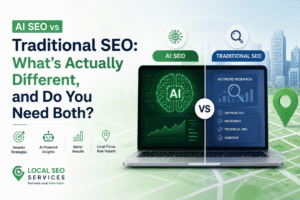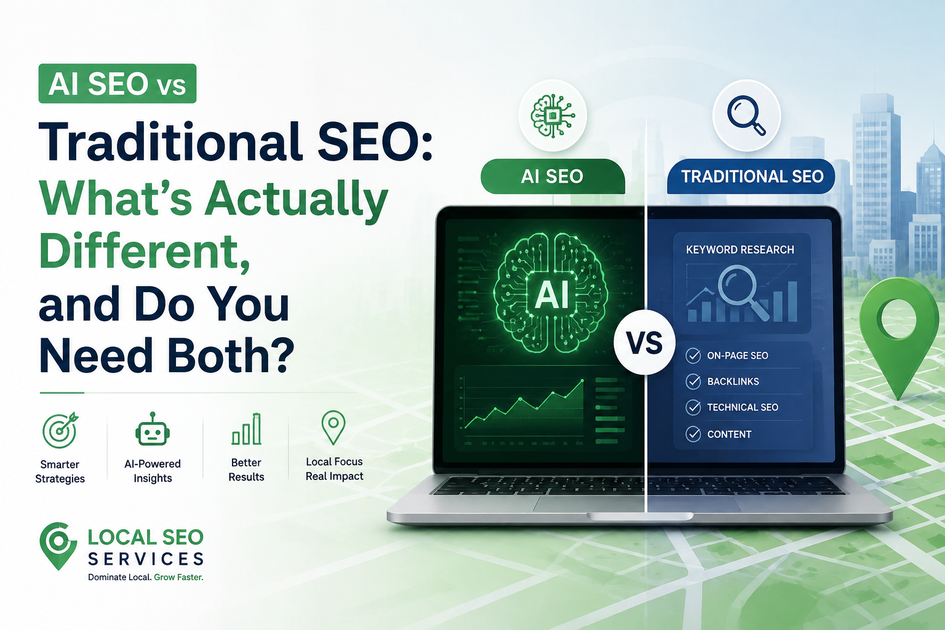
If you’ve searched anything about marketing lately, you’ve probably run into the phrase AI SEO vs traditional SEO and wondered whether one is about to replace the other. It’s a fair question. Google now answers a huge share of queries with an AI-generated summary before a single blue link shows up, and millions of people ask ChatGPT for recommendations the way they used to type into a search bar. So is traditional SEO dead? No. But it’s no longer the whole job either.
This guide breaks down what actually separates AI SEO from traditional SEO, where they overlap, where they pull in different directions, and how a business should realistically split its time and budget between the two in 2026.
Quick Answer
AI SEO vs traditional SEO, in short: traditional SEO optimizes a page to rank in a list of search results a person clicks through, while AI SEO (also called GEO, Generative Engine Optimization) optimizes content to be selected, summarized, and cited inside an AI-generated answer from tools like Google AI Overviews, ChatGPT, or Perplexity. Traditional SEO wins position. AI SEO wins the mention.
Table of Contents
- What Is Traditional SEO
- What Is AI SEO (GEO)
- The Core Difference: Ranking vs. Being Cited
- AI SEO vs Traditional SEO: Side-by-Side Comparison
- How Each One Actually Works
- Where They Overlap
- Common Mistakes Businesses Make
- Step-by-Step: Building a Strategy That Covers Both
- Expert Tips
- Frequently Asked Questions
- Key Takeaways
- Final Thoughts
What Is Traditional SEO
Traditional SEO is the practice of getting a webpage to rank as high as possible on a search engine results page, usually Google, so that people click through to your site. It rests on three pillars that haven’t really changed in two decades:
- Technical SEO – making sure your site can be crawled, indexed, and loaded quickly, with clean URLs and no broken links standing in the way.
- On-page SEO – using target keywords in your titles, headings, and body copy in a way that matches what people are actually searching for.
- Off-page SEO – earning backlinks and mentions from other sites, which signals to Google that other people trust your content.
The endpoint of traditional SEO is a click. You rank, the searcher clicks your listing instead of the nine others, and they land on your page. Everything about traditional SEO strategy, from meta descriptions to internal linking, is built around winning that click.
What Is AI SEO (GEO)
AI SEO, more precisely called Generative Engine Optimization, is a newer discipline aimed at a different endpoint: getting your content pulled into an AI-generated answer and, ideally, named as the source. When someone asks ChatGPT “what’s the best CRM for a small agency” or Google shows an AI Overview for “how does schema markup work,” these systems are pulling from a smaller pool of sources than a standard results page, deciding which ones are trustworthy enough to summarize, and often naming one or two by name.
That’s a fundamentally different game. There’s no page-two consolation prize. Either your content gets pulled into the answer, or it doesn’t get seen at all in that moment. AI SEO focuses on:
- Entity clarity – making it unambiguous who you are, what you do, and where you operate, so a model can confidently attach your name to an answer.
- Extractable structure – writing in a way that’s easy for a language model to lift a clean, accurate sentence or two out of, rather than burying the answer in a long narrative lead-up.
- Schema and structured data – giving machines a literal, unambiguous description of your business, services, and facts, not just prose they have to interpret.
- Consistency across the web – the same facts about your business showing up the same way on your site, your Google Business Profile, directories, and review platforms, so nothing contradicts and nothing gets flagged as unreliable.
If you want the fuller picture of how this works in practice, our own AI SEO Services page walks through the entity mapping, schema, and citation-focused approach we use with clients.
The Core Difference: Ranking vs. Being Cited
Here’s the cleanest way to think about it. Traditional SEO asks: “How do I outrank the page next to me?” AI SEO asks: “How do I become the source an AI system trusts enough to quote?”
Those two questions lead to different priorities. A page can rank #1 on Google and still get skipped entirely by an AI Overview if the content is hard to extract cleanly, or if the model has no strong entity signal tying the facts back to your brand. Meanwhile, a page ranking #4 or #5 sometimes gets cited inside the AI answer above it, simply because it states things more plainly and backs them up with specifics an AI model can lift without risk.
Neither approach makes the other obsolete. Traditional SEO still drives the majority of your organic traffic today. AI SEO is where an increasing share of that traffic is quietly leaking to, especially on informational searches where an AI summary now answers the question before anyone scrolls.
| AI SEO vs Traditional SEO: Side-by-Side Comparison | ||
|---|---|---|
| Factor | Traditional SEO | AI SEO (GEO) |
| Primary goal | Rank high in search results | Get cited inside an AI-generated answer |
| Success metric | Position, organic clicks, CTR | Citation frequency, brand mention accuracy, AI referral traffic |
| Content style | Keyword-optimized, built for scanning and ranking factors | Direct-answer, fact-dense, easy to extract in one or two sentences |
| Structure | Headings for readability and keyword placement | Headings that double as standalone answers a model can lift |
| Trust signals | Backlinks, domain authority, page experience | Entity consistency, schema markup, source agreement across the web |
| Platforms targeted | Google, Bing search results | Google AI Overviews, ChatGPT, Gemini, Perplexity, Copilot |
| Time to results | Weeks to months | Weeks for entity recognition, months for consistent citation |
| Where clicks happen | On your listing in the results page | Sometimes none at all — the user gets the answer without visiting |
| Core discipline | Keyword research, link building, technical audits | Entity SEO, structured data, content clarity, cross-platform consistency |
How Each One Actually Works
How traditional SEO ranks a page
Google’s crawlers index your page, evaluate hundreds of ranking signals, and slot you into a results page based on relevance, authority, and user experience. You compete against every other page targeting the same keyword, and your position can shift with algorithm updates, competitor content, or backlink changes.
How AI SEO gets you cited
An AI model doesn’t crawl the live web every time someone asks a question. It relies on a mix of training data and, for tools with live retrieval like Google AI Overviews or ChatGPT search, a smaller set of pages pulled in real time. The model then evaluates which sources are clear, consistent, and confidently attributable to a real, recognizable entity, and pulls a summary from those. If your business is described one way on your site and a slightly different way on your Google Business Profile, that inconsistency can quietly knock you out of contention, even if your content itself is good.
Where They Overlap
It’s worth saying plainly: AI SEO doesn’t replace traditional SEO, it builds on top of it. A site with weak technical foundations, thin content, or no backlink profile isn’t going to suddenly get cited by ChatGPT just because it added some schema markup. AI systems still lean heavily on the same underlying signals of authority and trust that traditional SEO has always cared about.
The overlap includes:
- Content quality. Both disciplines reward genuinely useful, well-researched content over thin filler.
- Technical health. A slow, broken, or unindexed site fails at both.
- Topical authority. Covering a subject comprehensively across multiple pages helps you rank and helps AI models recognize you as a credible source on that topic.
- Structured data. Schema markup has always helped traditional SEO earn rich results; it now does double duty helping AI models parse your facts accurately.
Common Mistakes
Chasing AI SEO while ignoring the basics. Some businesses hear “GEO” and want to jump straight to schema markup and entity optimization while their site still has broken links, slow load times, or thin content. AI systems are pickier about source quality than a standard search ranking, not less picky.
Writing content that never states a direct answer. A lot of blog content circles a topic for three paragraphs before actually answering the question. AI models skip that content in favor of pages that answer plainly and early. If you bury the point, you’re invisible to extraction.
Letting your business details drift across the web. Old NAP information, inconsistent service descriptions, or outdated business hours on third-party sites actively hurt your AI SEO, even when your own site is accurate.
Assuming AI SEO guarantees inclusion. No agency can promise you’ll be cited every time. What consistent entity signals and clear content do is meaningfully improve your odds, not lock in a guarantee.
Treating this as a one-time project. Both disciplines require ongoing maintenance. AI platforms retrain, re-crawl, and change how they select sources; a strategy that worked six months ago can quietly stop working without anyone noticing.
Step-by-Step: Building a Strategy That Covers Both
- Audit your technical foundation first. Fix crawl errors, page speed issues, and broken links before layering anything else on top.
- Map your business as a clear entity. Make sure your name, services, and location are described the same way everywhere: your site, Google Business Profile, directories, and social profiles.
- Structure content for extraction. Lead with a direct answer in the first two or three sentences of each section, then expand with supporting detail underneath.
- Implement schema markup on key pages. Organization, LocalBusiness, FAQ, and Article schema give both search engines and AI models a machine-readable version of your facts.
- Build topical depth, not just single pages. Cover a subject from multiple angles across linked content so both algorithms and language models see you as comprehensive.
- Keep earning backlinks. They still matter for traditional rankings and they still feed AI training and retrieval signals.
- Monitor both sets of metrics. Track your search rankings and organic clicks the way you always have, but also start watching for AI referral traffic and, where you can, whether you’re being named inside AI answers.
- Revisit quarterly. Update stats, refresh outdated claims, and re-check that your entity information hasn’t drifted anywhere on the web.
Expert Tips
- Write your most important fact or answer as a complete, standalone sentence near the top of each section. If it can be lifted out of context and still make sense, it’s AI-extraction-friendly.
- Avoid vague attribution like “many experts believe.” AI models trust specific, checkable claims more than soft generalizations, and so do readers.
- Don’t abandon keyword research. AI SEO still benefits from understanding what people actually ask, just phrased more as questions than as short-tail keywords.
- Check how your business is described on third-party sites every quarter. A stale listing can undercut months of on-site work.
- Treat FAQ sections as genuine opportunities, not filler. A well-written FAQ answer is one of the easiest formats for an AI model to extract cleanly.
Key Takeaways
- Traditional SEO optimizes for ranking position and clicks. AI SEO optimizes for being cited inside AI-generated answers.
- AI SEO builds on top of traditional SEO fundamentals, it doesn’t replace them.
- Entity consistency, structured data, and directly-stated answers are the core levers unique to AI SEO.
- Businesses ignoring either discipline are leaving visibility on the table, since both channels now drive real traffic and enquiries.
- Results from AI SEO typically take a few months to build, similar to traditional SEO timelines.
Final Thoughts
The honest answer to “AI SEO vs traditional SEO” is that this was never really a contest. It’s a shift in where attention goes after someone types a question, and businesses that adapt their content and technical foundation to both worlds are the ones that stay visible either way. If your current strategy hasn’t touched entity clarity, schema markup, or AI-specific content structure yet, that’s the gap worth closing next.
Frequently Asked Questions
Is AI SEO replacing traditional SEO?
No. AI SEO adds a new layer focused on how AI systems select and cite sources, but it depends on the same foundation of technical health, quality content, and authority signals that traditional SEO has always required. Businesses that drop traditional SEO in favor of AI SEO alone tend to lose ground on both fronts.
What does GEO stand for and how is it different from SEO?
GEO stands for Generative Engine Optimization. Where SEO optimizes for ranking position on a results page, GEO optimizes for being selected and quoted inside an AI-generated answer from tools like ChatGPT, Google AI Overviews, or Perplexity. The content quality bar is similar; the structure and framing needed to get extracted is what differs.
Do I need a separate content strategy for AI SEO?
Not entirely separate, but you do need to adjust how you write. Content built for AI extraction states direct answers early, avoids padding, and backs claims with specific, checkable facts. You can usually adapt your existing content strategy rather than building a parallel one from scratch.
How long does AI SEO take to show results?
Entity recognition improvements often show up within two to three months. Consistent citation inside AI-generated answers tends to strengthen over three to six months, depending on your existing digital footprint and how competitive your industry is.
Does schema markup actually help with AI SEO?
Yes. Schema markup gives search engines and AI models a precise, structured description of your business, services, and key facts, reducing the guesswork a model has to do when deciding whether to cite you accurately.
Can a small business compete in AI search against bigger brands?
Often more easily than in traditional search, actually. AI systems reward clarity and consistency more than sheer size or backlink volume. A small business with a clean entity profile and clear, well-structured content can get cited over a much bigger competitor with a messier online presence.
What’s the difference between AEO and GEO?
Answer Engine Optimization (AEO) focuses specifically on formatting content to directly answer questions, which helps with featured snippets, voice search, and AI answers alike. GEO is the broader discipline covering AI-specific structuring, entity signals, and citation optimization across all generative platforms. The two overlap heavily and are often used interchangeably in casual conversation.
Should I stop building backlinks if I’m focusing on AI SEO?
No. Backlinks remain one of the clearest trust signals for both traditional rankings and AI-driven citation decisions. Cutting link building to focus purely on AI-specific tactics usually backfires within a few months.
Does ranking #1 on Google guarantee I’ll show up in an AI Overview?
No. A page can rank first and still be skipped by an AI Overview if the content isn’t structured for easy extraction or if the entity signals around the brand are unclear. Conversely, pages ranking lower sometimes get cited if they answer more directly.
How do I check if my business is being mentioned by ChatGPT or other AI tools?
You can manually test common questions related to your industry and location inside ChatGPT, Perplexity, and Google AI Mode to see what comes up. For ongoing tracking, dedicated AI-visibility monitoring tools now track mention frequency and cited sources across multiple platforms over time.
Is keyword research still relevant for AI SEO?
Yes, but the framing shifts toward natural-language questions rather than short-tail keywords. Understanding what people actually ask, not just what they type, helps you structure content that matches how AI systems parse and retrieve information.
What industries benefit most from AI SEO right now?
Informational and research-heavy industries tend to see AI Overviews and AI answers most often, so businesses in health, technology, finance, and professional services typically see the biggest near-term impact. Local and service-based businesses are catching up quickly as AI platforms lean more on local intent and entity data.